15+ Absolute Truth Examples: A Search for Objective Reality
Does objective reality exist, or is everything relative? From mathematical constants like 2 + 2 = 4 to the universal laws of physics and morality, explore 15+ concrete examples of absolute truth to ground your search for what is real.

The Search for Truth: Why Objective Reality Matters
In a world increasingly defined by "personal truths" and subjective narratives, the search for what is objectively real has never been more critical. Whether you are approaching this through the lens of philosophy, religion, or hard science, the foundation of any coherent worldview rests on the existence of absolute truths.
An absolute truth (often called a "universal truth") is not a matter of opinion. It is a reality that exists independently of the human mind. If every human being on Earth disappeared tomorrow, these truths would remain unchanged.
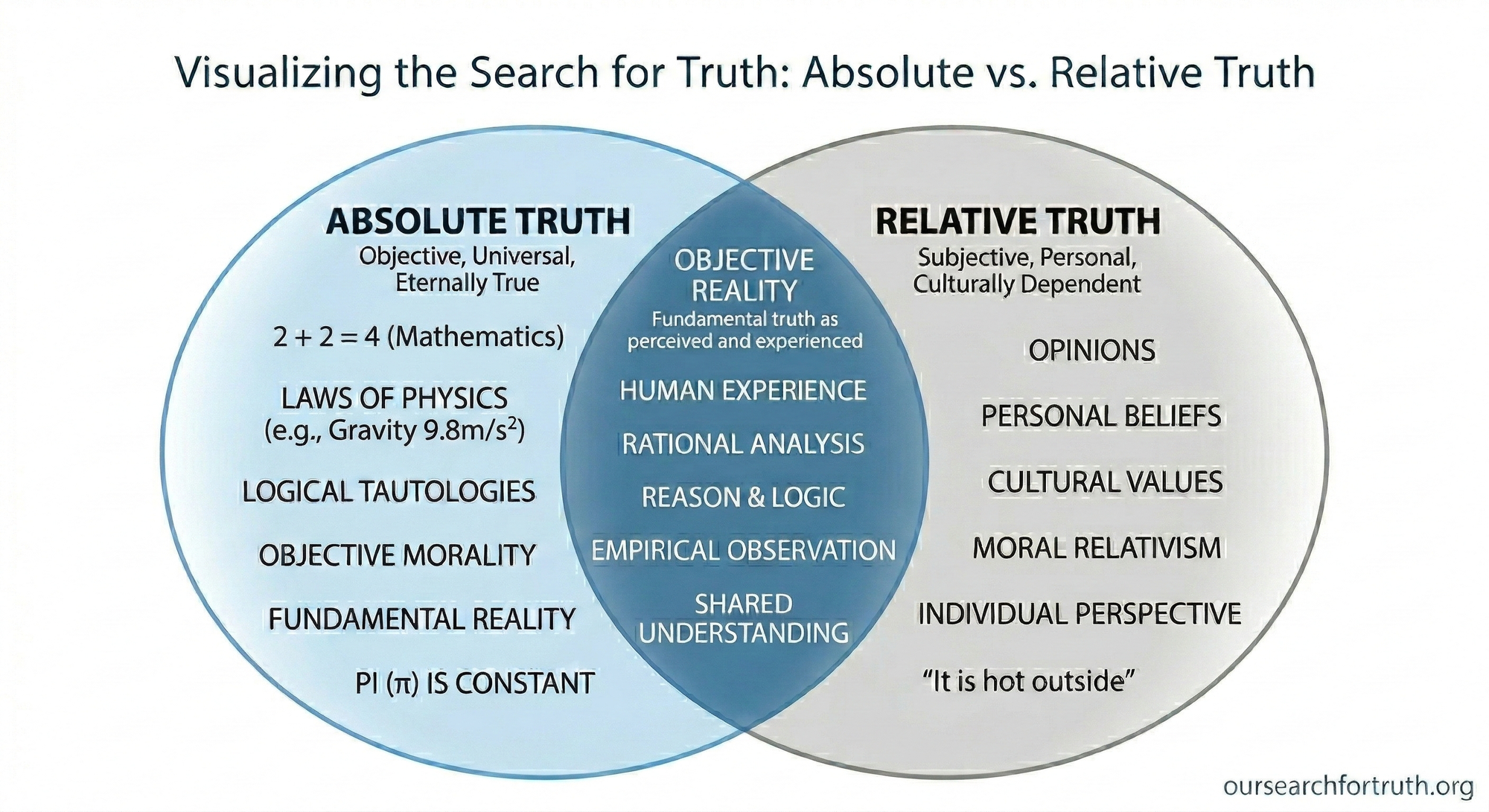
The Difference Between Absolute and Relative Truth
Before diving into specific examples, it is vital to distinguish between two types of "truth" we encounter daily:
- Absolute Truth: True for all people, in all places, at all times (e.g., "Gravity exists").
- Relative Truth: True based on a person’s perspective, feelings, or cultural location (e.g., "It is cold outside").
This article explores over 15 concrete examples of absolute truth across mathematics, science, logic, and morality to help clarify the boundaries of our objective reality.
Section 1: Mathematical and Logical Absolutes
Mathematical and logical truths are the most "bulletproof" examples of absolute reality. They do not rely on physical observation or human opinion; they are true by their very definition and internal structure. If the universe were empty, these relationships would still be true.
Mathematical Constants
- Arithmetic Certainty (2 + 2 = 4): This is the quintessential absolute truth. In any base-10 system, the sum of two units and two more units is always four. It is not subject to cultural interpretation, historical era, or personal feeling.
- The Internal Angles of a Triangle: In Euclidean geometry, the sum of the interior angles of a flat triangle will always be 180°. This is a geometric constant that remains true regardless of who is measuring it.
- The Pythagorean Theorem (a² + b² = c²): The relationship between the sides of a right triangle is an absolute mathematical law that has remained unchanged since its discovery.
The Universal Laws of Logic
Logic provides the "rules of the game" for all rational thought. Without these absolute truths, communication and science would be impossible.
- The Law of Identity: A thing is what it is ($A = A$). A tree is a tree; it cannot be "not a tree" at the same time and in the same sense.
- The Law of Non-Contradiction: Contradictory propositions cannot both be true at the same time. You cannot be both "entirely in Utah" and "entirely in New York" simultaneously.
- The Law of Excluded Middle: For any specific statement, either that statement is true or its negation is true. There is no "middle" ground where a fact is both true and false.
Section 2: Scientific Laws and Physical Constants
While scientific theories can evolve as we gain more data, Scientific Laws describe phenomena that have been observed to be universally true. These are the "rules of the physical universe" that do not change based on who is observing them.
The Law of Gravity
Gravity is an absolute truth of the physical realm. On Earth, the acceleration due to gravity is approximately 9.8 m/s². Whether you believe in gravity or not, if you drop an object, it will fall toward the center of the Earth. This is a universal constant that applies to all physical matter in the universe, governing everything from the falling of an apple to the orbits of entire galaxies.
The Second Law of Thermodynamics (Entropy)
This law states that in an isolated system, the total entropy (disorder) can never decrease over time. This is an absolute truth of our physical reality: things naturally move from a state of order to a state of disorder. You can see this in the way a hot cup of coffee always cools down to room temperature, or how a building eventually decays if left unmaintained. It is a one-way street of time and energy that remains true across the entire cosmos.
The Speed of Light (c)
In a vacuum, light always travels at exactly 299,792,458 meters per second. This is a fundamental physical constant. It is not "faster" for some people and "slower" for others; it is an absolute limit of the universe. This constant is the foundation for Einstein’s theory of relativity and our entire understanding of space-time.
Section 3: Moral and Ethical Absolutes
While "moral relativism" suggests that right and wrong are merely matters of cultural opinion, many philosophers and theologians argue that certain moral truths are objective and universal. These are truths that remain "right" or "wrong" regardless of whether a society accepts them.
The Principle of Non-Maleficence (The Harm Principle)
The idea that it is objectively wrong to cause unnecessary suffering to an innocent being is a cornerstone of global ethics. While the definition of "innocent" or "unnecessary" might be debated, the core truth, that suffering is intrinsically negative, is an absolute. This is the foundation for almost every legal system and moral code in human history, from the "Golden Rule" to modern human rights.
Universal Human Rights
The belief that every human being possesses an inherent dignity and certain "inalienable rights" (such as the right to life and liberty) is treated as an absolute truth in international law. These rights are not "granted" by governments; they are recognized as existing inherently. To deny these rights is seen as a violation of an objective moral reality, not just a difference in cultural preference.
The Law of Reciprocity (The Golden Rule)
"Treat others as you would like to be treated." This principle appears in virtually every major religion and philosophical tradition, from Ancient Egypt and Greece to the teachings of Jesus, Confucius, and Buddha. Its universal appearance across isolated cultures suggests it is an absolute ethical truth discovered by humanity, rather than a social construct created by one group.
The Master List: 15+ Concrete Examples of Absolute Truth
To help clarify the boundaries of objective reality, here is a categorized list of absolute truths that remain constant regardless of human opinion.
Mathematical & Geometric Absolutes
- 2 + 2 = 4: The fundamental truth of basic arithmetic.
- The Value of Pi: The ratio of a circle's circumference to its diameter is always approximately 3.14159...
- The Sum of a Triangle’s Angles: In flat (Euclidean) geometry, this is always exactly 180°.
- Prime Numbers: A number like 7 is only divisible by 1 and itself, a fact that remains true in any corner of the universe.
- The Pythagorean Theorem: a² + b² = c² for all right-angled triangles.
Logical & Philosophical Absolutes
- The Law of Identity: A = A. A thing is identical to itself.
- The Law of Non-Contradiction: A statement cannot be both true and false at the same time and in the same sense.
- The Law of Excluded Middle: Every proposition is either true or its negation is true.
- The "Cogito": "I think, therefore I am." The absolute truth that the act of doubting one's existence proves the existence of the doubter.
- Mathematical Logic: If A=B and B=C, then A=C (The Transitive Property).
Scientific & Physical Absolutes
- The Constant Speed of Light: In a vacuum, light always travels at 299,792,458 m/s.
- The Law of Gravity: Massive objects will always exert an attractive force on one another.
- The Second Law of Thermodynamics: Entropy (disorder) in an isolated system always increases over time.
- Absolute Zero: The theoretical temperature where all molecular motion stops (0 Kelvin or -273.15°C).
- The Law of Conservation of Energy: Energy cannot be created or destroyed, only transformed.
Moral & Ethical Absolutes
- The Harm Principle: Causing intentional, unnecessary suffering to an innocent being is objectively wrong.
- The Law of Reciprocity: The "Golden Rule" (Treating others as you wish to be treated) as a universal ethical foundation.
- Inherent Human Dignity: The absolute truth that every human life possesses intrinsic value.
4. The Relativism Trap: Why Denying Absolute Truth is Logically Impossible
In modern discourse, it is common to hear the phrase, "There is no such thing as absolute truth." However, this statement itself falls into a logical trap. If the statement is true, then it is an absolute truth that there are no absolute truths—which is a direct contradiction.
Philosophers call this a "self-refuting statement." To search for truth is to acknowledge that a destination exists. If we deny the existence of objective reality, we lose the ability to distinguish between fact and fiction, right and wrong, or progress and decline.
The Role of Subjectivity in an Objective World
Acknowledging absolute truth does not mean that human perspective doesn't matter. While the truth is absolute, our perception of it is often relative. We may see different parts of the same mountain, but the mountain itself remains a single, objective reality. The goal of the "Search for Truth" is to align our subjective perspectives as closely as possible with the objective facts of the universe.
Conclusion: The Foundation of Your Search for Truth
Whether you are calculating the trajectory of a rocket, debating the ethics of a new law, or pondering the nature of existence, you are relying on the existence of absolute truths. From the 2+2=4 of basic arithmetic to the universal constants of physics and the core principles of human morality, these truths provide the stable ground upon which we build our lives.
The search for truth isn't just an academic exercise, it is the most important journey a human being can take. By grounding ourselves in what is objectively real, we find the clarity needed to navigate a complex world.