Different Types of Religion: A Comprehensive Guide to Global Belief Systems
What are the different types of religion? From Abrahamic and Dharmic to modern secular movements, explore our 2026 guide to the global search for truth.
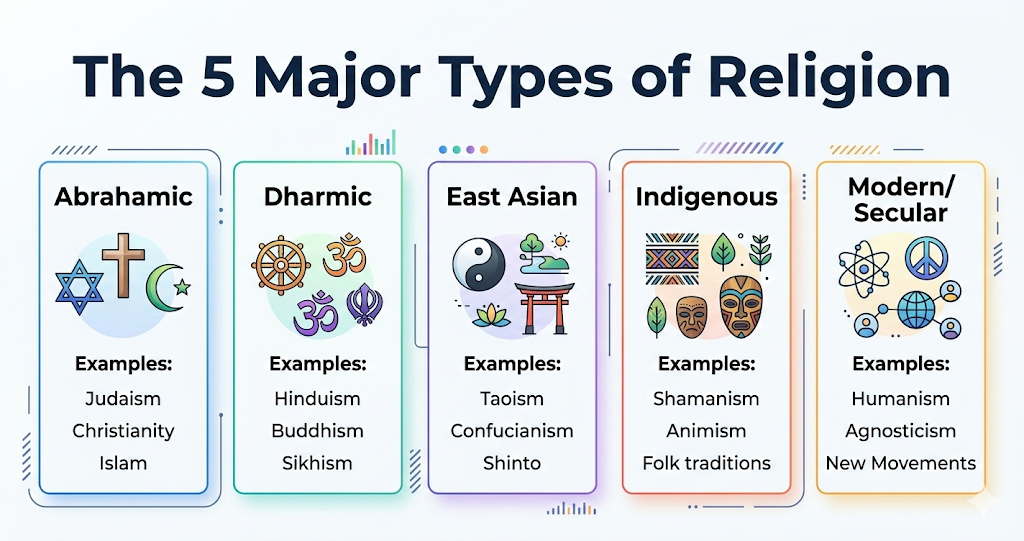
Section 1: The Global Landscape of Belief
What are the Different Types of Religion? (The 2026 Overview)
The world’s religious landscape is traditionally classified into five primary categories based on their historical origins, core philosophies, and geographical roots: Abrahamic, Dharmic, East Asian, Indigenous (Folk), and New Religious Movements. While thousands of sub-sects exist, these five pillars represent the vast majority of human spiritual inquiry and organized belief systems today.
⛪ Abrahamic Religions: Monotheistic faiths (Christianity, Islam, Judaism).
☸️ Dharmic Religions: Faiths centered on Dharma and rebirth (Hinduism, Buddhism, Sikhism).
☯️ East Asian Philosophies: Systems focusing on Tao and harmony (Taoism, Confucianism, Shinto).
🌿 Indigenous & Folk Religions: Traditional, nature-based beliefs of specific ethnic groups.
🕊️ Modern & Secular Movements: 21st-century belief systems and Secular Humanism.
Why Categorization Matters in the "Search for Truth"
Understanding the different types of religion is more than just a brain exercise; it is a roadmap for the human search for truth. Every system above attempts to answer the same fundamental questions: Where did we come from? Why are we here? And what is our moral obligation to one another? By categorizing these beliefs, we can better analyze the Logic of Truth (how they claim to know what is real) and the Application of Ethics (how those truths dictate behavior). Whether through revelation, meditation, or observation, each "type" offers a unique lens through which to view morality and the divine.
Section 2: How We Categorize Faith (The "Big Three" Frameworks)
While listing religions is helpful, understanding how they are categorized allows for a deeper "Search for Truth." Scholars and theologians generally use three primary frameworks to classify world belief systems: Deity Structure, Geographic Origin, and Growth Intent.
| Framework | Primary Focus | Key Examples |
|---|---|---|
| Deity Structure | Concepts of the Divine | Monotheism, Polytheism, Nontheism |
| Geographic Origin | Eastern vs. Western Roots | Abrahamic vs. Dharmic Faiths |
| Growth & Membership | How the faith expands | Universal vs. Ethnic Religions |
The most common way to distinguish religions is by their concept of the "Divine." This is the foundational logic of any spiritual truth-claim:
Monotheism
Belief in a single, all-powerful Creator (e.g., Christianity, Islam, Judaism, Sikhism).
Polytheism
Belief in multiple deities, often representing different aspects of nature or human life (e.g., Ancient Greek religion, Shinto, some forms of Hinduism).
Pantheism
The belief that the universe and the Divine are one and the same; God is not a separate being but the sum of all things (e.g., certain branches of Taoism or Spinozism).
Nontheism
Systems that do not center on a creator-god but rather on ethical living, meditation, or cosmic law (e.g., Theravada Buddhism, Jainism, Secular Humanism).
Religions are often grouped by where they emerged, as geography heavily influences their philosophical "flavor":
- Western (Middle Eastern) Religions: Primarily the Abrahamic faiths. These tend to be linear (beginning, middle, and end of the world) and focus on revelation from God to humanity.
- Eastern (Indian & Asian) Religions: Including Dharmic and Taoic faiths. These often view time as cyclical (birth, death, and rebirth) and focus on internal enlightenment or social harmony.
Religions are often grouped by where they emerged, as geography heavily influences their philosophical "flavor":
Finally, we look at how a religion interacts with the rest of the world:
- Universal (Proselytizing) Religions: Faiths that actively seek new members and believe their truth is applicable to all people regardless of culture (e.g., Christianity, Islam, Buddhism).
- Ethnic Religions: Faiths deeply tied to a specific ethnic group or location. They generally do not seek converts, as the religion is part of a shared cultural heritage (e.g., Judaism, Hinduism, Shinto).
Section 3: The Major Branches (The Core Families)
To truly navigate the "Search for Truth," we must look at the specific lineages of belief. Most global faiths belong to one of three massive "families" of thought: The Abrahamic traditions, the Dharmic traditions, and the East Asian philosophies.
1. The Abrahamic Traditions (Monotheistic)
Judaism
The foundation of the Abrahamic tradition. It focuses on the covenant between God and the people, emphasizing law, tradition, and the study of the Torah. Core Truth: God is one, and human life is governed by divine law and ethical conduct.
Christianity
The world’s largest religion, centered on the life and teachings of Jesus Christ. It emphasizes grace, salvation, and the Great Commandment to love one's neighbor. Core Truth: Jesus is the path to reconciliation with God and the ultimate expression of divine love.
Islam
Based on the revelations received by the Prophet Muhammad, Islam emphasizes total submission (aslama) to the will of Allah. Core Truth: There is no god but Allah, and Muhammad is His messenger; life is a journey of obedience to the Five Pillars.
2. The Dharmic Traditions (Indian)
Hinduism
One of the world’s oldest religions, Hinduism is a diverse tapestry of beliefs ranging from monotheism to polytheism, all unified by the search for Moksha (liberation from the cycle of rebirth). Core Truth: The individual soul (Atman) is identical to the ultimate reality (Brahman).
Buddhism
Founded by Siddhartha Gautama (the Buddha), this tradition focuses on the "Middle Way" and the elimination of suffering through the Four Noble Truths. Core Truth: Suffering can be overcome through the Eightfold Path, leading to Enlightenment or Nirvana.
Sikhism
A monotheistic faith that emphasizes the equality of all humans, selfless service, and the constant remembrance of God. Core Truth: There is one Creator, and the highest path is a life of honesty, sharing, and service.
3. East Asian Philosophies (Taoic)
Taoism (Daoism)
Focuses on living in harmony with the Tao—the underlying flow of the universe. It emphasizes simplicity, spontaneity, and non-interference (Wu Wei). Core Truth: Truth is found by yielding to the natural order of the world rather than resisting it.
Confucianism
A system of ethical and social philosophy that emphasizes filial piety, ritual, and the cultivation of virtue to create a stable society. Core Truth: Morality is built through correct relationships and the fulfillment of social roles.
Shinto
The indigenous religion of Japan, centered on the Kami (spirits) that inhabit the natural world. It focuses on purity and the connection between ancient traditions and modern life. Core Truth: The divine is present in all of nature, and harmony is maintained through ritual and gratitude.
Section 4: The Master Comparison Table (2026 Overview)
To see the "Search for Truth" in action, it is helpful to compare the world's most prominent belief systems side-by-side. While every religion is nuanced, this table provides a high-level comparison of their origins, primary texts, and core philosophical goals.
| Religion | Primary Text | Core Goal | Ethical Source |
|---|---|---|---|
| Christianity | The Bible | Salvation & Grace | Divine Command |
| Islam | The Quran | Submission to Allah | Divine Command |
| Judaism | The Torah | Covenant & Law | Divine Command |
| Hinduism | The Vedas | Moksha (Liberation) | Cosmic Law (Karma) |
| Buddhism | Tripitaka / Sutras | Nirvana (End of Suffering) | Cosmic Law (Karma) |
| Sikhism | Guru Granth Sahib | Union with God | Cosmic Law (Karma) |
| Taoism | Tao Te Ching | Harmony with the Tao | Natural Balance |
| Shinto | Kojiki / Nihon Shoki | Purity & Harmony | Natural Balance |
- The Abrahamic faiths (Christianity, Islam, Judaism) often derive their ethics from Divine Command: the idea that truth is revealed from above.
- The Dharmic faiths (Hinduism, Buddhism, Sikhism) often derive their ethics from Cosmic Law: the idea that truth is woven into the fabric of the universe (Karma).
- The East Asian systems (Taoism, Shinto) often derive their ethics from Natural Balance: the idea that truth is found by observing and respecting the world around us.
By understanding these "types," you can better evaluate which philosophical framework resonates with your personal search for objective truth.
Section 5: Modern & Secular Movements (The Search for Truth Today)
The landscape of belief is shifting. In the 21st century, the "Search for Truth" often leads away from traditional institutions and toward systems of thought that prioritize human reason, scientific inquiry, and individual experience.
The "Nones" are the fastest-growing demographic in the West. This term describes individuals who do not identify with any specific organized religion. This group is far from a monolith and includes:
Atheism
The absence of belief in a deity or deities, often based on a lack of empirical evidence.
Agnosticism
The philosophical position that the existence of the divine or supernatural is unknown or inherently unknowable.
Spiritual but Not Religious (SBNR)
Individuals who reject organized dogma but seek a connection to something "greater"— through nature, mindfulness, or art.
2. Secular Humanism
Secular Humanism is a comprehensive life stance that emphasizes Reason, Ethics, and Social Justice. It rejects the supernatural and instead focuses on the potential and responsibility of humans to lead ethical lives without divine intervention.
3. New Religious Movements (NRM)
While some move toward secularism, others find truth in faiths that emerged in the 19th and 20th centuries. These "New Religious Movements" often attempt to bridge the gap between ancient wisdom and modern globalism.
The Baháʼí Faith
A global religion emphasizing the spiritual unity of all humankind and the essential worth of all religions.
Unitarian Universalism
A liberal religion characterized by a "free and responsible search for truth and meaning" rather than a shared creed.
Section 6: Conclusion, Your Journey in the Search for Truth
Navigating the different types of religion is the first step in a much larger intellectual and spiritual journey. Whether you are drawn to the divine revelations of the Abrahamic faiths, the cosmic balance of the Dharmic traditions, or the reason-based frameworks of Secular Humanism, the common thread is the human desire for meaning.