Flawed Reasoning: How Logical Fallacies Sabotage Our Work and Relationships
Most arguments at work or home aren't about facts—they are about glitches in reasoning. Learn how to spot and fix 4 common logical fallacies.

We like to think of ourselves as deeply rational creatures. We believe that when a disagreement arises at the office conference table or the kitchen counter, we are simply evaluating facts, weighing evidence, and pursuing the objective truth.
The reality is far messier. Humans are emotional, tribal creatures, and when our ideas or behaviors are challenged, our brains routinely drop strict logic in favor of conversational survival tactics. We stop seeking truth and start trying to win.
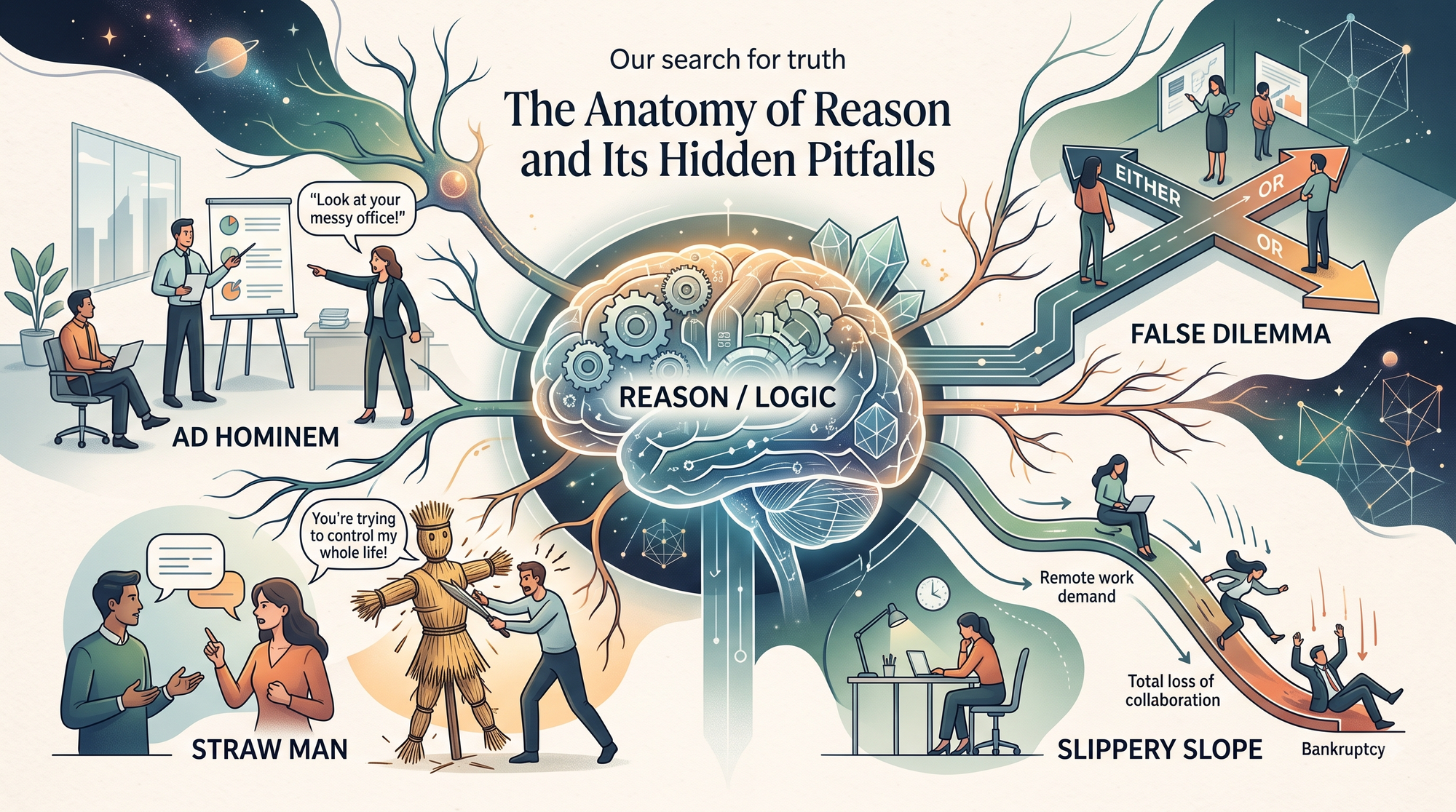
The Anatomy of Reason and Its Hidden PitfallsIn philosophy, these conversational bugs are known as logical fallacies, which are flaws in reasoning that render an argument invalid. While they are often studied in university classrooms or analyzed in political debates, their most destructive work happens in our daily lives. They are the invisible friction behind stalled career projects, toxic corporate cultures, and repetitive, exhausting arguments with the people we love most.
To uncover the truth in our daily interactions, we must first learn to recognize where our reasoning loops fail. Let’s look at how these fallacies weaponize themselves in our closest relationships.
Section 1: The Kitchen Table (Fallacies in Relationships)
Interpersonal relationships are the ultimate breeding ground for logical fallacies. When we argue with a romantic partner, a sibling, or a close friend, the emotional stakes are incredibly high. Fear of rejection, defensive egos, and years of shared history combine to create a perfect storm where logic is frequently the first casualty.
When relationship conflicts heat up, two specific fallacies do the heavy lifting of driving people apart.
1. The Straw Man: Arguing with a Caricature
The Straw Man fallacy occurs when someone takes an opponent's actual argument, twists or exaggerates it into an extreme version, and then attacks that exaggerated caricature instead of addressing the real point. It is called a straw man because a dummy made of straw is far easier to knock down than a real human being.
In a relationship, this happens when we don't actually listen to what our partner is saying, but instead react to the worst possible interpretation of their words.
How It Plays Out in Real Life Imagine a typical Saturday morning conversation about household responsibilities:
Partner A: "Hey, I've been feeling a bit overwhelmed lately. Do you think we could set up a cleaner schedule so the housework is shared a bit more evenly?"
Partner B: "Oh, I get it. So you think I’m completely lazy and do absolutely nothing around here? You expect me to spend my entire weekend scrubbing floors after working a 50-hour week?"
Notice what Partner B just did. Partner A made a reasonable, localized request about organizing housework. Partner B completely bypassed that request and constructed a "straw man", the accusation that they are fundamentally lazy and being forced into weekend labor. Partner B then attacks this unfair caricature, leaving Partner A defending themselves against a charge they never made. The original issue (sharing housework) is completely abandoned.
To beat the Straw Man fallacy at home, you have to commit to active tracking. Before your brain allows you to get offended and fire back a defense, consciously echo back your partner’s exact premise. A healthy pivot sounds like this: "It sounds like you're feeling exhausted with the house right now and want to figure out a better system together. Is that right?" By validating the actual argument on the table, you prevent the conversation from devolving into a fight against a ghost.
2. Ad Hominem: Attacking the Person, Not the Problem
Translated from Latin, Ad Hominem literally means "to the man." This fallacy occurs when an individual avoids engaging with the substance of an argument and instead launches a personal attack against the character, past behavior, or personality traits of the person making it.
In relationships, Ad Hominem is the ultimate nuclear option. It shifts a disagreement from a solvable problem into a referendum on a person’s worth.
How It Plays Out in Real Life Consider a dispute regarding financial management:
Partner A: "I noticed we went over budget on dining out again this month. Maybe we should try to meal-prep a bit more so we can keep our savings goals on track."
Partner B: "Are you seriously lecturing me about money? You’re the one who forgot to pay the water bill on time last year. You've always been completely disorganized, so don't act like a financial genius now."
Partner A’s argument is entirely structural: the budget is over, and meal prepping is a potential solution. Partner B, feeling threatened or guilty, completely ignores the budget data. Instead, they dig into the past to launch an Ad Hominem attack, labeling Partner A as "disorganized."
Whether Partner A forgot a bill a year ago has absolutely zero bearing on the mathematical truth of the current month's overspending. But by attacking the person, Partner B successfully hijacks the conversation, turning a collaborative financial check-in into a toxic defensive battleground.
When an Ad Hominem attack slips into an argument, the truth is instantly obscured by emotional smoke. To fix it, you have to draw a hard line between character and events. If you are on the receiving end, pull the focus back immediately: "My past mistakes are a separate conversation we can have, but right now, the numbers on this spreadsheet are what we need to figure out. Let's look at this month's budget together."
Section 2: The Conference Room (Fallacies at Work)
If the kitchen table is where logical fallacies go to stir up emotional drama, the corporate conference room is where they go to protect egos, defend bad decisions, and kill innovative ideas.
In the workplace, the stakes are measured in revenue, project deadlines, and professional status. When a project falls behind or a new strategy threatens the status quo, the pressure to look right often overrides the desire to be right. Tribalism shifts from family dynamics to departmental silos.
When professional panic sets in, teams routinely fall prey to two highly destructive fallacies that stall progress and destroy collaboration.
1. The False Dilemma: The Trap of Binary Choices
Also known as Black-and-White Thinking or the Either/Or fallacy, the False Dilemma occurs when an argument presents a complex situation as having only two possible outcomes, completely ignoring a wide spectrum of middle-ground alternatives. Usually, one option is painted as completely reasonable (the speaker’s preferred choice) while the other is framed as an absolute catastrophe.
In business, this fallacy is often used as a high-pressure manipulation tactic to force quick agreement and bypass deeper, more nuanced strategic thinking.
How It Plays Out in Real Life Imagine a product launch meeting where a critical decision needs to be made about a tight timeline:
"Look, the new software still has a few major bugs, but we have a hard deadline on Friday. Either we launch the platform this Friday as scheduled, or we miss our window entirely, lose the client's trust, and our entire department faces massive budget cuts next quarter."
* Option A: Launch a broken product on Friday.
* Option B: Postpone the launch and watch the company collapse.
By framing the issue this way, the Project Lead forces the team into a corner. They have created an artificial, high-stakes binary. In reality, a third, fourth, or fifth option almost always exists.
Could they do a soft launch for a small subset of users? Could they launch on time but explicitly disable the buggy feature while issuing a patch notice? Could they have a transparent conversation with the client to adjust the scope of Friday's delivery?
The False Dilemma suffocates creativity and pushes companies into making high-risk, unforced errors because it tricks the brain into seeing an ultimatum instead of a problem.
To break a False Dilemma in a meeting, you have to actively reject the premises being offered. Do not choose between the two bad options. Instead, name the fallacy out loud and enforce a brainstorming buffer.
Try a reframe like this: "You've given us two choices, both of which have severe downsides. Let's step back. What is a third option that allows us to preserve client trust without shipping broken software?"
Forcing your team to generate at least three alternatives breaks the psychological paralysis of binary thinking.
2. The Slippery Slope: Fear-Driven Resistance to Innovation
The Slippery Slope fallacy relies entirely on fear and exaggeration. It happens when someone argues against a specific action by claiming that it will inevitably set off a catastrophic chain reaction of negative events, ultimately leading to a worst-case scenario.
The core flaw in this reasoning is that the speaker provides absolutely no evidence or data to prove that the first step will actually trigger the final disaster; they simply expect you to accept the terrifying momentum of their imagination.
In corporate environments, the Slippery Slope is the ultimate weapon of change-resistance. It is frequently deployed by traditionalists to kill new workflows, technology adoptions, or cultural shifts before they can even be piloted.
How It Plays Out in Real Life Consider a leadership debate regarding a shift toward modern workspace flexibility:
Director of Operations: "If we allow the sales and marketing teams to work from home on Thursdays, it’s only a matter of time before they start demanding to work from home full-time. Before you know it, our collaboration will entirely evaporate, our corporate culture will collapse, productivity will hit rock bottom, and we’ll be out of business within a year."
1. Allow one work-from-home day 2. Full-time remote demands 3. Total loss of collaboration 4. Company culture collapses 5. Bankruptcy
Notice the massive leaps in logic. The Director treats a controlled, single-day policy adjustment as an automatic ticket to complete corporate insolvency. Each link in that chain is an assumption masquerading as an absolute certainty.
While it is entirely reasonable to weigh the pros and cons of shifting workflows, treating the very first step of an experiment as a guarantee of ultimate doom prevents an organization from ever evolving.
The best way to halt a Slippery Slope is to systematically dismantle the chain of events. Force the speaker to defend each individual step with data rather than emotion.
You can counter this by saying: "I understand you're concerned about long-term productivity, but let's isolate the first step. What specific data do we have that shows a single remote day leads to a complete breakdown in team communication? And if that does happen, what metrics or guardrails can we put in place to catch it early?"
By treating the change as a measurable pilot program with explicit boundaries, you pull the conversation out of a hypothetical nightmare and back into a manageable reality.
Section 3: The Universal Truth-Killer (Confirmation Bias)
While logical fallacies are the specific structural flaws in our arguments, they don't operate in a vacuum. They are fueled by a deeper, more insidious psychological phenomenon that bridges both the boardroom and the living room: Confirmation Bias.
Confirmation bias is our subconscious habit of seeking out, interpreting, and remembering information in a way that confirms our preexisting beliefs, while completely ignoring or downplaying any evidence to the contrary. If a logical fallacy is a glitchy line of code in our thinking, confirmation bias is the operating system running it.
When we approach our work or our relationships through the lens of confirmation bias, we actively distort reality to protect our current narrative.
Preexisting Belief ➔ Filter Out Disproving Evidence ➔ Hyper-Focus on Supporting Data ➔ Belief Reinforced
How It Coordinates with Fallacies Consider how this bias supercharges the fallacies we've already discussed:
* In Relationships: If you subconsciously believe your partner is fundamentally inconsiderate, your confirmation bias will hyper-focus on the one time they forgot to take out the trash. It will completely filter out the five times they filled your car with gas or made you coffee. When an argument starts, your bias feeds your brain the raw material needed to build a massive Straw Man or launch a devastating Ad Hominem attack.
* At Work: If you believe a younger colleague is underqualified, your confirmation bias will flag every minor typo in their emails as proof of incompetency, while ignoring the brilliant strategy deck they built last week. When they pitch a new idea, your bias instantly uses a Slippery Slope argument to kill it, because your brain has already decided their input is a liability.
Confirmation bias transforms our minds into echo chambers where finding the truth becomes nearly impossible, because we are only looking for a reflection of what we already think.
Conclusion: Trading Victory for Truth
At the heart of every logical fallacy and cognitive shortcut is a simple, primal desire: the urge to protect our ego and win the argument. But winning a flawed argument is a hollow victory. It builds resentment with our partners, stalls innovation with our colleagues, and isolates us from the actual reality of our lives.
To search for truth, whether in our personal relationships or our professional endeavors, requires a willingness to be wrong. It demands that we prioritize clean reasoning over defensive positioning.
The next time an argument heats up at the office or at home, break the pattern by running through this practical framework:
Step 1: The Strategic Pause: The moment you feel your chest tighten and your defensive instincts kick in, stop talking. Recognize that your brain is attempting to shift from truth-seeking mode to survival mode. Give yourself five seconds to evaluate your internal state before uttering a word.
Step 2: Identify the Glitch: Analyze the incoming argument, and your own impending response. Are you about to build a Straw Man because you're hurt? Are you leaning on a Slippery Slope because you are afraid of a new corporate workflow? Explicitly label the reasoning error in your own mind.
Step 3: Reframe for Collaboration: Pull the conversation back to the data. Strip away the character attacks and the binary ultimatums. Reframe the discussion by asking a collaborative question: "What problem are we actually trying to solve right now, and what does the objective data tell us?"
"Finding the truth isn’t something that happens by defeating an opponent. It’s an ongoing, active discipline of clearing away the cognitive smoke so we can see the world—and each other—clearly."
By mastering the anatomy of our arguments, we stop pushing people away and start building systems, teams, and relationships rooted in what is genuinely real.